Introduction
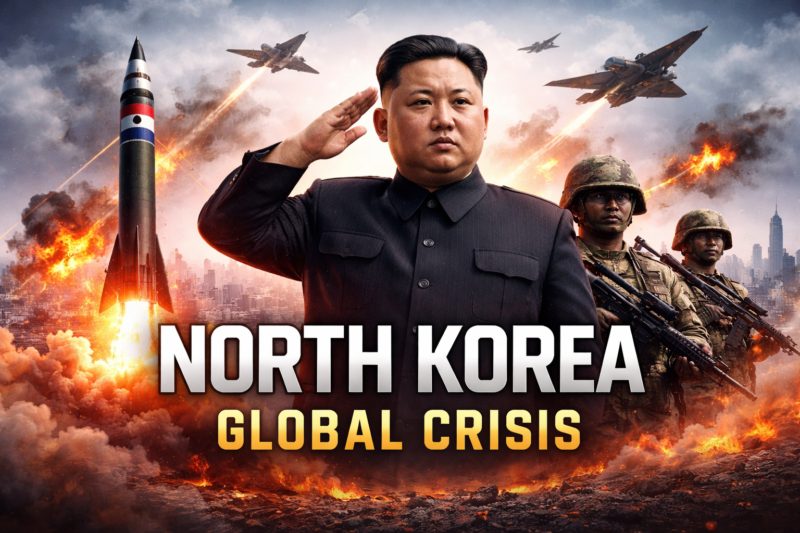
North Korea Global War Scenario is one of the most serious geopolitical concerns in modern international security. Analysts around the world closely monitor the possibility of North Korea entering a major international conflict that could reshape global politics, disrupt economic systems, and threaten regional stability in East Asia.
For decades, the Korean Peninsula has remained one of the most militarized regions on Earth. The presence of nuclear weapons, large military forces, and complex geopolitical alliances makes the situation particularly sensitive.
Understanding the North Korea Global War Scenario requires examining several factors, including military power, nuclear capabilities, regional alliances, and global economic consequence
North Korea, officially known as the Democratic People’s Republic of Korea (DPRK), occupies a unique position in global geopolitics. Despite its relatively small economy and isolation from much of the international community, the country maintains one of the world’s largest standing armies and has developed an increasingly sophisticated nuclear weapons program.
If North Korea were to become directly involved in a global conflict, the consequences would extend far beyond the Korean Peninsula. Such a scenario could disrupt international trade, destabilize global financial markets, trigger humanitarian crises, and potentially escalate into a wider confrontation involving multiple major powers.
Understanding the strategic, military, economic, and humanitarian implications of this possibility is essential for policymakers, analysts, and citizens who follow global security developments.
This article provides a comprehensive analysis of:
- The historical roots of the Korean conflict
- North Korea’s military and nuclear capabilities
- Potential triggers for military escalation
- Regional and global consequences
- The role of major powers such as the United States, China, and Russia
- The impact on the global economy and supply chains
- Possible diplomatic solutions and future scenarios
Historical Roots of the Korean Peninsula Conflict

The origins of the Korean conflict date back to the end of World War II in 1945. After Japan’s surrender, the Korean Peninsula was divided into two zones along the 38th parallel.
The northern zone came under Soviet influence, while the southern zone was administered by the United States.
This division eventually led to the creation of two separate states:
- North Korea (Democratic People’s Republic of Korea)
- South Korea (Republic of Korea)
Each government claimed legitimacy over the entire peninsula.
The ideological divide between communism and capitalism intensified tensions, eventually leading to the outbreak of the Korean War in 1950.
The Korean War
In June 1950, North Korean forces crossed the 38th parallel and launched a large-scale invasion of South Korea.
The war quickly escalated as:
- United Nations forces led by the United States intervened
- China entered the conflict in support of North Korea
- The Soviet Union provided indirect support
The war lasted three years and resulted in millions of casualties.
In 1953, an armistice agreement ended active combat but did not establish a permanent peace treaty. As a result, the two Koreas technically remain in a state of war.
North Korea’s Military Structure

North Korea maintains one of the largest military forces in the world relative to its population.
Active Personnel
Estimates suggest that North Korea has:
- Over 1.2 million active military personnel
- Millions of reserve troops
- Large paramilitary organizations
The military plays a central role in North Korean society and politics.
The country’s leadership has long emphasized a policy known as “Songun”, or military-first policy, which prioritizes defense and military readiness.
Conventional Weapons
North Korea possesses a large number of conventional weapons systems, including:
- Tanks
- Armored vehicles
- Artillery systems
- Rocket launchers
- Naval vessels
Many of these systems are older compared to modern Western equipment, but their sheer quantity still represents a formidable force.
Artillery Threat to Seoul
One of North Korea’s most significant military advantages is its artillery positioned near the Demilitarized Zone.
Thousands of artillery pieces could potentially target the Seoul metropolitan area within minutes of a conflict starting.
Given that Seoul is home to more than 25 million people, this presents a major strategic concern.
North Korea’s Nuclear Weapons Program

North Korea’s nuclear weapons program is one of the most controversial and closely monitored aspects of its military strategy.
Early Development
North Korea began pursuing nuclear technology during the Cold War with assistance from the Soviet Union.
However, the program accelerated significantly in the late 20th and early 21st centuries.
Nuclear Tests
North Korea conducted its first nuclear test in 2006.
Since then, several additional tests have been carried out, each demonstrating increasing explosive power.
Estimates suggest that North Korea may now possess dozens of nuclear warheads.
Intercontinental Ballistic Missiles
North Korea has developed several missile systems capable of long-range strikes.
Examples include:
- Hwasong-14
- Hwasong-15
- Hwasong-17
These missiles could potentially reach targets thousands of kilometers away. Nuclear threat explained in Nuclear War Explained
Potential Triggers for a Global Conflict
Several scenarios could lead to North Korea becoming involved in a larger international war.
Military Escalation on the Peninsula
Small incidents along the border could escalate rapidly.
Examples include:
- Naval clashes
- Missile tests
- Airspace violations
Strategic Alliances
If tensions between major powers escalate globally, North Korea could align itself with certain blocs.
Such alliances could expand a regional conflict into a broader geopolitical confrontation.
Political Calculations
Leadership decisions often play a significant role in international crises.
Strategic calculations about deterrence, prestige, and domestic politics may influence military decisions.
Impact on South Korea
South Korea would likely be the most directly affected country if conflict erupted.
Major cities such as Seoul and Busan could face:
- missile strikes
- artillery bombardment
- infrastructure disruption
South Korea is also one of the world’s most technologically advanced economies.
Industries that could be affected include:
- semiconductor manufacturing
- electronics production
- automotive manufacturing
Disruptions in these sectors could have global ripple effects.
Impact on Japan
Japan plays a critical role in regional security.
The country hosts several U.S. military bases that could become strategic targets in a conflict.
Potential risks for Japan include:
- missile strikes
- cyber attacks
- maritime security disruptions
Japan’s proximity to the Korean Peninsula makes it highly vulnerable during any escalation.
China’s Strategic Role
China shares a border with North Korea and has historically been one of its most important partners.
China’s primary concerns include:
- regional stability
- preventing refugee flows across its border
- avoiding military confrontation with the United States
China often advocates diplomatic negotiations as the preferred solution.
Russia’s Potential Role
Russia also maintains diplomatic relations with North Korea.
In recent years, cooperation between the two countries has increased in certain areas.
While Russia’s direct involvement in a Korean conflict remains uncertain, geopolitical developments could influence its strategic decisions.
Global Economic Impact


A conflict involving North Korea could trigger widespread economic disruptions.
Global Trade Routes
East Asia is a critical hub for global shipping and manufacturing.
Major sea routes in the region handle a significant portion of global trade.
Disruptions in these routes could lead to higher shipping costs and delays.
Technology Supply Chains
South Korea and Japan are major producers of advanced semiconductor chips.
These components are essential for:
- smartphones
- computers
- automobiles
- artificial intelligence systems
A supply disruption could affect industries worldwide.
Financial Markets
Geopolitical crises often lead to volatility in global financial markets.
Investors may shift assets toward safer investments such as gold or government bonds.
Cyber Warfare and Digital Conflict
Modern warfare increasingly includes cyber operations.
North Korea has developed notable cyber capabilities over the years.
Potential cyber actions during a conflict could target:
- financial systems
- communication networks
- government infrastructure
Cyber warfare can disrupt societies even without traditional military attacks.
Humanitarian Consequences
A major war on the Korean Peninsula would likely result in a significant humanitarian crisis.
Millions of civilians could be displaced.
Neighboring countries might face large refugee movements.
International humanitarian organizations would likely play a critical role in providing assistance.
Geographical Importance of the Korean Peninsula in Global Security

The Korean Peninsula occupies one of the most strategically significant locations in East Asia. Positioned between major regional powers such as China, Russia, and Japan, the peninsula has historically been a focal point for geopolitical competition.
This geographic position has shaped Korea’s role in global politics for centuries. The peninsula lies at the crossroads of major maritime trade routes and is close to some of the world’s most important economic centers.
For global powers, control or influence over the Korean Peninsula can provide strategic advantages in several areas:
- Military positioning in Northeast Asia
- Access to critical shipping lanes
- Influence over regional security dynamics
- Proximity to major industrial economies
Because of these factors, conflicts involving the Korean Peninsula rarely remain isolated. Instead, they often draw the attention and involvement of larger powers.
The presence of multiple international actors in the region increases both the complexity and the risks associated with any military escalation.
The Role of the Demilitarized Zone (DMZ)

The Demilitarized Zone, commonly known as the DMZ, is one of the most heavily fortified borders in the world.
Despite its name, the DMZ is far from demilitarized. Both North and South Korea maintain significant military forces near the border.
The DMZ stretches approximately 250 kilometers across the Korean Peninsula and acts as a buffer zone separating the two countries.
Over the decades, the DMZ has become a symbol of the unresolved conflict between North and South Korea.
Military incidents along this border have occasionally escalated tensions, including:
- artillery exchanges
- naval clashes
- infiltration attempts
- surveillance incidents
While large-scale conflict has been avoided, the constant military presence on both sides means that any misunderstanding or miscalculation could potentially escalate into a larger confrontation.
North Korea’s Military Doctrine and Strategy
Understanding North Korea’s military doctrine is essential to analyzing how the country might behave in a larger conflict.
North Korea’s military strategy is based on several key principles:
Deterrence Through Strength
North Korea emphasizes strong military capabilities to deter potential adversaries. By demonstrating its ability to retaliate, the country seeks to discourage attacks against its territory.
Asymmetric Warfare
North Korea cannot match the technological superiority of some major powers. Instead, it relies on asymmetric strategies such as:
- missile strikes
- cyber warfare
- special operations forces
- artillery bombardment
These tactics allow the country to offset technological disadvantages.
Rapid Escalation Strategy
Some analysts believe North Korea may adopt a strategy of rapid escalation during a conflict. The goal would be to create immediate pressure on adversaries and force negotiations quickly.
This approach could involve simultaneous military actions across multiple domains.
Special Operations Forces

North Korea reportedly maintains one of the largest special operations forces in the world.
These units are trained for missions such as:
- reconnaissance
- sabotage operations
- infiltration behind enemy lines
- targeted military strikes
Special operations forces could play a critical role in the early stages of any conflict by disrupting enemy infrastructure or communications. Strategic military data can also be reviewed through
Stockholm International Peace Research Institute.
Because these units are highly mobile and trained for unconventional operations, they present unique challenges for opposing forces.
Naval Capabilities of North Korea
Although North Korea’s navy is smaller compared to those of major maritime powers, it still possesses significant capabilities within regional waters.
The navy operates a variety of vessels, including:
- submarines
- patrol boats
- missile-equipped ships
Submarines are particularly important because they can operate covertly and potentially launch missile strikes.
In a conflict scenario, naval operations might focus on:
- protecting coastal regions
- disrupting shipping routes
- conducting surprise attacks
Control of nearby seas could become an important strategic objective.
Air Defense Systems
North Korea has invested heavily in air defense systems designed to protect key infrastructure and military installations.
These systems include:
- radar networks
- anti-aircraft artillery
- surface-to-air missile systems
While some systems are older, upgrades and modernization efforts have improved their effectiveness.
Air defense capabilities are critical because air superiority often determines the outcome of modern conflicts.
Global Diplomatic Reactions
If North Korea were to enter a large-scale conflict, the international diplomatic response would be immediate.
Countries around the world would likely convene emergency meetings in international forums such as:
- the United Nations Security Council
- regional security organizations
- diplomatic alliances
Diplomatic efforts would likely focus on:
- ceasefire negotiations
- humanitarian assistance
- conflict de-escalation
History shows that international diplomacy often plays a crucial role in preventing regional conflicts from expanding into global wars.
Information Warfare and Propaganda
Modern conflicts involve not only physical battles but also information warfare.
Governments and organizations use media, social platforms, and communication channels to shape public perception.
Information campaigns may aim to:
- influence international opinion
- maintain domestic morale
- counter opposing narratives
In the digital age, information warfare can spread rapidly and influence global audiences.
Impact on Global Energy Markets
Energy markets are highly sensitive to geopolitical instability.
If conflict disrupts shipping routes or regional stability, oil and gas prices could increase significantly.
Countries that rely heavily on energy imports may experience:
- higher fuel costs
- inflationary pressure
- economic uncertainty
Energy supply disruptions have historically triggered global economic shocks.
Global Humanitarian Response
In the event of a large-scale conflict involving North Korea, international humanitarian organizations would play a critical role.
Relief agencies could be involved in:
- providing emergency food assistance
- medical support for injured civilians
- refugee shelter programs
- rebuilding damaged infrastructure
Humanitarian responses often require cooperation between governments, non-governmental organizations, and international institutions.
Environmental Consequences of War
War can have significant environmental impacts.
Potential environmental consequences could include:
- industrial pollution from damaged facilities
- fires and chemical leaks
- destruction of ecosystems
- long-term contamination of land and water
Environmental damage can persist long after a conflict has ended.
Reconstruction efforts often include environmental restoration as a key priority.
Long-Term Political Consequences
Conflicts often reshape international political systems.
If North Korea were to become involved in a large global conflict, the long-term consequences could include:
- new security alliances
- shifts in regional power balances
- changes in military strategies
- increased investment in defense technologies
Historical examples show that major conflicts frequently lead to new geopolitical structures.
Lessons from Past Conflicts
History provides valuable insights into how conflicts escalate and how they can be resolved.
Studying past conflicts such as:
- the Korean War
- the Cold War
- regional conflicts in Asia
helps policymakers understand the importance of diplomacy, deterrence, and crisis management.
These lessons remain relevant in today’s complex geopolitical environment.
Conclusion
The possibility of North Korea entering a global conflict represents one of the most serious geopolitical risks of the modern era.
While many factors continue to prevent such a scenario, the potential consequences highlight the importance of diplomacy, deterrence, and international cooperation.
Understanding these dynamics helps analysts and citizens better evaluate the evolving security landscape of the 21st century.

Mohit Tejwani is a geopolitics writer and researcher focused on global conflicts, international relations, and military strategy. He analyzes ongoing global tensions and provides simplified insights into complex world events.