
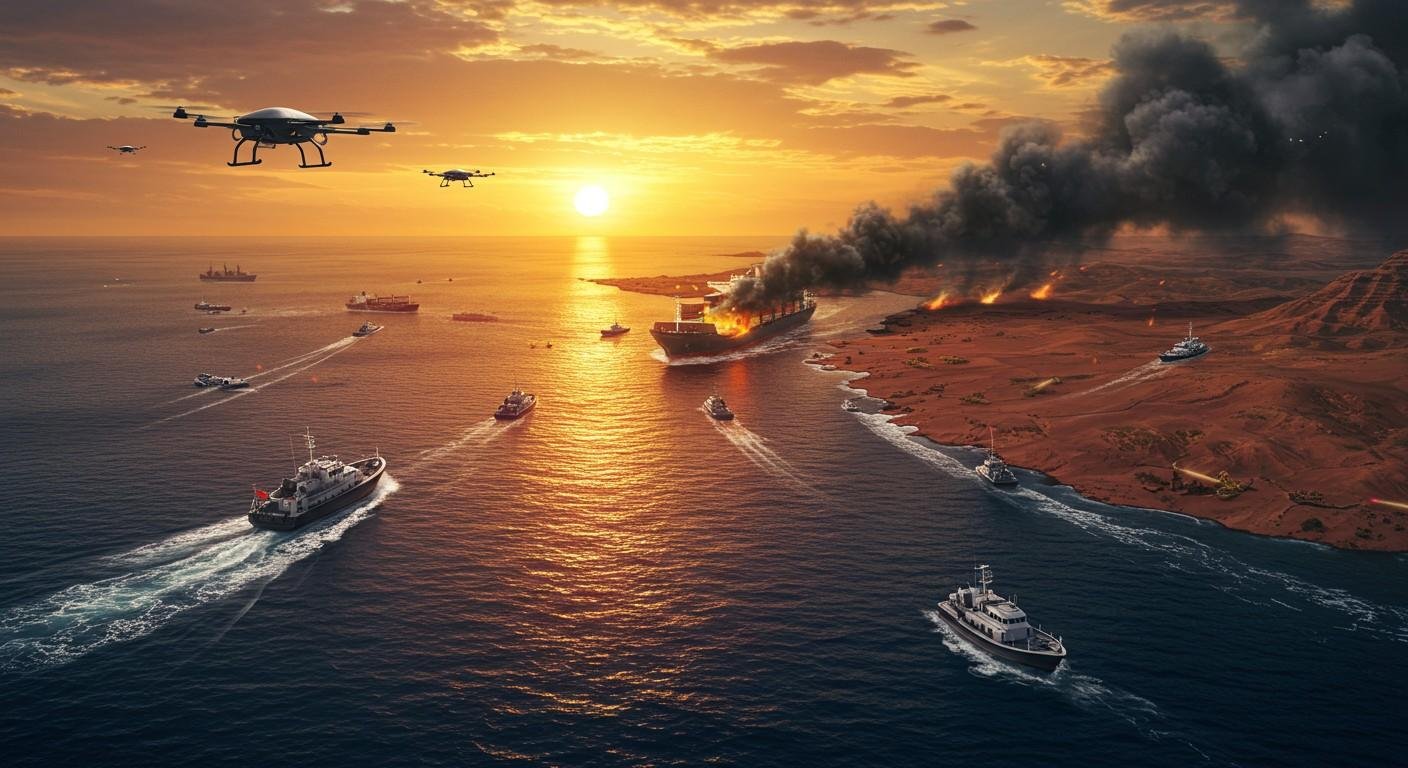
Introduction: A Global Crisis in One of the World’s Most Important Sea Routes

Red Sea Attacks 2026 have become a major global concern, disrupting shipping routes and international trade. These attacks, largely linked to Houthi rebels, are impacting economies, oil prices, and supply chains worldwide.
But why exactly are ships being attacked? Who is behind these attacks? And what does this mean for global trade, economies, and even everyday consumers?
To understand the full picture, we need to look beyond headlines and examine the geopolitics, military strategies, economic consequences, and regional conflicts that have converged to create this crisis. Experts believe that Red Sea Attacks 2026 could continue if tensions in the Middle East remain unresolved.
1. Why the Red Sea Matters So Much
Before diving into the attacks, it’s important to understand why the Red Sea is so critical.
The Red Sea connects:
- The Mediterranean Sea (via the Suez Canal)
- The Indian Ocean (via the Bab el-Mandeb Strait)
This makes it one of the most important maritime trade routes in the world.
Key Facts:
- Around 15% of global trade passes through this route
- It is crucial for oil, gas, and container shipping between Asia and Europe
- It significantly reduces travel time compared to sailing around Africa
When this route is disrupted, the impact is immediate and global.
2. Who Is Attacking Ships in the Red Sea?
The primary actors behind these attacks are the Houthi rebels from Yemen.
Who Are the Houthis?

The Houthis are:
- A Yemeni armed group involved in a long-running civil war
- Supported politically and militarily by Iran
- Opposed by a coalition led by Saudi Arabia and supported by Western powers
They have evolved from a regional militia into a force capable of:
- Launching missiles and drones
- Conducting naval attacks
- Disrupting global shipping routes
3. The Real Trigger: The Israel–Gaza War
The current wave of attacks began in late 2023 and continues into 2026.
What sparked it?
The Houthis declared they were attacking ships:
- In solidarity with Palestinians
- To pressure Israel and its allies
According to analysis:
- The attacks were framed as a way to force global powers to push for a ceasefire in Gaza
- Initially, they targeted Israel-linked ships
- Later, targets expanded to include U.S., UK, and even unrelated vessels
Over time, this mission evolved from political signaling into wider maritime disruption. The ongoing Red Sea Attacks 2026 are not isolated incidents but part of a broader geopolitical strategy.
4. How the Attacks Are Carried Out
The attacks are not random—they are strategic and technologically advanced.
Common Methods Used:
- Drones (UAVs) – used to strike ships from a distance
- Anti-ship missiles – launched from Yemen’s coastline
- Speedboats – used for boarding or harassment
- Hijackings – such as the seizure of commercial vessels
By early 2024:
- At least 40+ ships had been attacked
- Many more incidents followed into 2025 and 2026
Even ships with no clear connection to Israel or the West have been targeted due to misidentification or escalation .
5. Why Attacks Continued into 2026
You might assume this would have ended by now—but it hasn’t.
Here’s why:
5.1 Ongoing Middle East Tensions


The Red Sea crisis is no longer isolated—it is part of a larger regional conflict involving:
- Iran vs United States & allies
- Israel vs Hamas
- Proxy groups like the Houthis
In 2026, tensions escalated further:
- Houthis signaled readiness to support Iran militarily
- Attacks are now part of a broader regional power struggle
5.2 Strategic Leverage by Iran
Iran benefits indirectly from these attacks:
- It pressures Western economies
- It disrupts oil and trade routes
- It strengthens its influence through proxy groups
Experts suggest:
- Attacks may be used as a strategic bargaining tool in conflicts involving Iran
5.3 Weak Deterrence
Despite military responses:
- U.S. and UK conducted airstrikes in Yemen
- Naval patrols increased
But:
- The Houthis continue to operate
- Deterrence is described as “under tension, not resolution”
6. Why Ships Without Any Connection Are Also Being Attacked
One of the most alarming developments is that neutral ships are also at risk.
Reasons include:
- Misidentification of ownership
- Broad targeting criteria
- Intentional escalation
Ships from over 40 countries have been affected
This has turned the Red Sea into a high-risk zone for all maritime traffic, not just politically linked vessels.
7. The Economic Impact on Global Trade

The consequences of these attacks are massive.
7.1 Shipping Routes Are Changing
Many companies have:
- Avoided the Red Sea entirely
- Rerouted ships around the Cape of Good Hope
This results in:
- Longer travel times
- Increased fuel costs
- Delayed deliveries
7.2 Higher Costs Worldwide
The disruption has caused:
- Increased shipping costs
- Rising insurance premiums
- Supply chain delays
This ultimately affects:
- Consumer goods prices
- Fuel prices
- Inflation globally
7.3 Impact on the Suez Canal
The Suez Canal has seen:
- A major drop in traffic
- Billions in lost revenue
Shipping disruptions have already reduced global trade flows and caused economic instability .
8. Military Response and Global Security Efforts
Countries have not remained passive.
Key actions include:
- U.S. naval deployments in the region
- Coalition forces protecting shipping lanes
- Airstrikes targeting Houthi positions
Despite this:
- Ships are still being rerouted
- Military escorts are not foolproof
Even U.S. naval vessels have avoided the Red Sea in some cases due to risks .
9. Why This Crisis Is So Hard to Solve
There is no quick solution because the problem is multi-layered.
Key challenges:
- Non-state actors (Houthis) are harder to deter
- Conflict is tied to larger geopolitical issues
- Red Sea geography makes defense difficult
- Attacks are cheap but effective
Even a small group can disrupt global trade—a major shift in modern warfare .
10. The Role of Geography: A Perfect Chokepoint
The Red Sea’s geography makes it especially vulnerable.
Key chokepoints:
- Bab el-Mandeb Strait (near Yemen)
- Suez Canal
These narrow passages:
- Make ships easy targets
- Are difficult to secure completely
This is why even limited attacks can have outsized global effects.
11. The Ripple Effects on Everyday Life
You may not see ships being attacked—but you feel the effects.
How it impacts you:
- Higher prices for imported goods
- Increased fuel costs
- Delays in electronics, cars, and clothing
- Rising inflation
This crisis is not just geopolitical—it directly affects households worldwide.
12. What Could Happen Next?
Looking ahead, several scenarios are possible:
Scenario 1: Escalation
- More attacks
- Wider regional war
- Complete shutdown of Red Sea routes
Scenario 2: Controlled Stability
- Limited attacks continue
- Military presence stabilizes routes
- Shipping partially resumes
Scenario 3: Diplomatic Resolution
- Ceasefire agreements
- Reduced tensions
- Gradual return to normal shipping
However, as of 2026:
- The situation remains volatile and unpredictable
13. Why This Crisis Is Historically Significant
The Red Sea attacks mark a turning point:
- Small groups can disrupt global trade
- Maritime security is no longer guaranteed
- Supply chains are more fragile than expected
This is not just a regional conflict—it’s a global system shock.
Conclusion: A Conflict That Goes Beyond the Sea
The attacks on ships in the Red Sea in 2026 are not random acts of violence—they are the result of a complex mix of:
- Regional wars
- Global power struggles
- Strategic geography
- Economic pressure tactics
At the center of it all are the Houthis, using asymmetric warfare to influence global events far beyond Yemen.
What makes this crisis unique is how a localized conflict has escalated into a global economic and security issue. In conclusion, Red Sea Attacks 2026 highlight how regional conflicts can disrupt global trade and economic stability. Latest global shipping updates can be found via Reuters
Until the underlying geopolitical tensions—especially those involving Iran, Israel, and Western powers—are resolved, the Red Sea will likely remain one of the most dangerous and strategically important waterways in the world. You can learn more about how Global Conflicts Affects Oil Prices in our detailed analysis.

Mohit Tejwani is a geopolitics writer and researcher focused on global conflicts, international relations, and military strategy. He analyzes ongoing global tensions and provides simplified insights into complex world events.





2 Comments