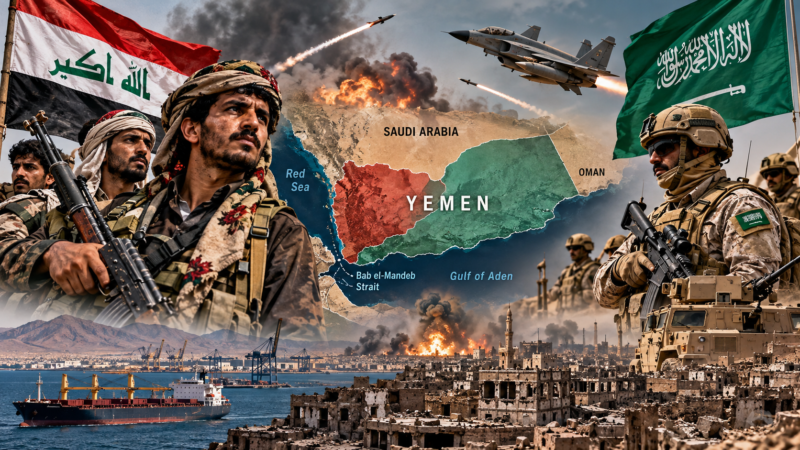
Houthi vs Saudi Arabia War is one of the most complicated conflicts of the 21st century. What began as a Yemeni political and civil conflict eventually developed into a major regional confrontation involving Saudi Arabia, Iran, the United Arab Emirates and other international powers.
It is tempting to describe it as a straightforward confrontation between Saudi Arabia and the Houthis, but Yemen’s war has never involved only two sides. At different stages, the conflict has included the internationally recognized Yemeni government, the Houthi movement, Saudi Arabia, the United Arab Emirates, Iran, southern separatists, tribal forces, Al-Qaeda in the Arabian Peninsula, the United States, the United Kingdom and other international actors.
The roots of the conflict go back decades, but the modern war entered a decisive phase in 2014, when the Houthi movement seized Sana’a, Yemen’s capital. Saudi Arabia intervened militarily in March 2015 after President Abd-Rabbu Mansour Hadi’s government requested outside assistance. The United Nations records March 26, 2015 as the beginning of the Saudi-led military intervention.
What followed was years of airstrikes, missile and drone attacks, ground battles, blockades, economic collapse and humanitarian suffering.
A UN-backed truce beginning in April 2022 dramatically reduced major fighting, although it formally expired in October of that year. The military situation remained comparatively stable for several years, while negotiations continued.
But in 2026, Yemen again moved into a dangerous period of escalation.
By September 2026, renewed fighting had produced major territorial changes and a rapidly growing displacement crisis. UN agencies reported more than 130,000 people displaced since the beginning of September, while WHO reported thousands of casualties during the broader recent escalation.
That makes Yemen’s conflict relevant not only to the Middle East but also to international energy markets, shipping through the Red Sea and the strategic Bab el-Mandeb Strait.


Where Is Yemen and Why Does It Matter?
Yemen occupies the southwestern corner of the Arabian Peninsula.
It borders:
- Saudi Arabia to the north
- Oman to the east
- The Red Sea to the west
- The Gulf of Aden to the south
Across the Red Sea from Yemen are African countries including Djibouti and Eritrea.
This geography gives Yemen enormous strategic importance.
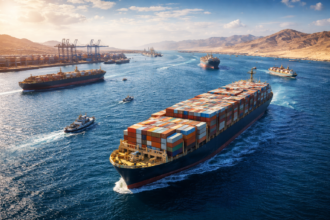
At the southwestern end of Yemen lies the Bab el-Mandeb Strait, a narrow maritime passage connecting the Red Sea with the Gulf of Aden and ultimately the Indian Ocean.
For centuries, this location has been important for trade.
In the modern era, its importance is even greater because commercial ships use the Red Sea route to travel between Europe and Asia through the Suez Canal.
A prolonged security crisis around Yemen can therefore affect:
- container shipping
- oil transportation
- insurance costs
- global supply chains
- military deployments
- regional energy security
The strategic geography helps explain why the Yemen war became much larger than a domestic conflict.


Yemen Before the Current War
To understand the Houthi–Saudi conflict, it is necessary to understand Yemen’s political history.
Modern Yemen was created through the unification of North Yemen and South Yemen in 1990.
Ali Abdullah Saleh, who had governed North Yemen, became president of the unified country.
But unification did not eliminate Yemen’s political, economic and regional divisions.
The country contained:
- northern and southern political identities
- tribal structures
- religious differences
- economic inequalities
- competing political factions
- disagreements over distribution of power and resources
Southern separatist sentiment remained important after unification.
In 1994, a civil war broke out when southern forces attempted to restore independence. Saleh’s government defeated the separatists.
The political system remained highly centralized around Saleh.
Over time, dissatisfaction increased.
One of the most important developments occurred in northern Yemen among communities belonging to the Zaydi branch of Shia Islam.
This community had historically been concentrated in northern Yemen.
The Houthi movement emerged from this environment.
Who Are the Houthis?
The Houthis are formally known as Ansar Allah, meaning “Supporters of God.”
The movement takes its name from the Houthi family, particularly its early leader Hussein Badreddin al-Houthi.
The movement emerged in northern Yemen as a religious, cultural and political revival movement among Zaydis.
Its origins are sometimes traced to the 1990s.
Initially, the movement focused heavily on religious and cultural issues and opposition to the policies of President Ali Abdullah Saleh.
Relations between the Houthis and Saleh’s government deteriorated dramatically.
Between 2004 and 2010, the government and Houthi forces fought several rounds of conflict in northern Yemen.
Saudi Arabia eventually became directly involved in one of these earlier conflicts.
That earlier confrontation is important because it demonstrated that the Houthi issue could cross the Yemen–Saudi border even before the 2015 intervention.
The Houthis gradually developed from a relatively localized insurgency into a significant military and political organization.
Their strength was based partly on:
- knowledge of Yemen’s mountainous terrain
- tribal alliances
- military experience
- captured weapons
- organizational networks
- recruitment
- political mobilization
- later development of missiles and drones
Iran’s relationship with the Houthis became increasingly important, although the exact nature and extent of Iranian assistance has been debated over the years.
Saudi Arabia and its allies have described the Houthis as an Iranian-backed force.
The Houthis reject the description of themselves as simply an Iranian proxy and emphasize their Yemeni identity and independent political objectives.
There is substantial evidence of Iranian assistance and technological support, while the degree of operational independence exercised by the Houthis remains an important part of the debate surrounding the conflict.
The UN Security Council has imposed an arms embargo on the Houthi movement and has documented attacks attributed to the group against civilian infrastructure and Saudi and UAE targets.
The Arab Spring Changes Yemen
The next major turning point came in 2011.
The Arab Spring protests spread across the Middle East and North Africa.
Yemen also experienced large demonstrations against President Saleh.
After months of political pressure and international mediation, Saleh eventually left office in 2012.
His vice president, Abd-Rabbu Mansour Hadi, became president during a transitional process.
The transition was intended to produce:
- a new political system
- constitutional reform
- national dialogue
- greater power sharing
- a more stable Yemen
Instead, political disagreements intensified.
Different factions disagreed over:
- federalism
- regional boundaries
- political representation
- military restructuring
- resource distribution
- the future role of former Saleh loyalists
The Houthis increasingly opposed the transition.
A particularly important issue was the government’s decision to remove fuel subsidies in 2014.
The resulting price increases became a powerful political mobilization issue.
The Houthis used public dissatisfaction to expand their influence.
Their movement increasingly moved beyond its traditional northern strongholds.
The Houthis Capture Sana’a
The decisive turning point came in September 2014.
Houthi forces entered and seized large parts of Sana’a.
The government lost control of the capital.
The Houthis were helped by an unexpected political and military relationship.
Former president Ali Abdullah Saleh and forces loyal to him temporarily aligned with the Houthis.
The alliance was strategically important.
Saleh had extensive political and military networks.
The Houthis had their own fighters and northern support networks.
Together, they became powerful enough to challenge the government.
The United Nations describes the situation as escalating after Houthi forces and allied military units seized Sana’a and other areas in September 2014.
The situation deteriorated further in January 2015.
President Hadi and members of his government were placed under pressure and resigned.
Hadi eventually escaped first to Aden and then to Saudi Arabia.
At this point, Saudi Arabia faced a strategic problem.
A powerful armed movement aligned with Yemen’s former president now controlled the capital.
And that movement had increasingly close relations with Iran.
Saudi leaders feared that an Iran-aligned armed group could establish a strong position directly on Saudi Arabia’s southern border.
Why Did Saudi Arabia Intervene?
Saudi Arabia’s intervention had several interconnected objectives.
Protecting the Saudi–Yemen border
Saudi Arabia shares a long border with Yemen.
A hostile armed organization operating across the border represented a direct security concern.
Restoring the internationally recognized government
President Hadi remained internationally recognized.
Saudi Arabia presented its intervention as an effort to restore Yemen’s legitimate government.
The UN records that Hadi formally requested military assistance from regional organizations before the coalition intervention.
Limiting Iranian influence
Saudi Arabia and Iran were already regional rivals.
The rise of the Houthis was therefore interpreted in Riyadh not simply as a Yemeni domestic problem but as part of a wider regional competition.
Preventing a hostile force from controlling strategic territory
Yemen contains the Bab el-Mandeb Strait and extensive Red Sea coastline.
Control of parts of Yemen’s western coastline has military and economic implications.
Operation Decisive Storm: March 2015
On March 26, 2015, Saudi Arabia launched a major military intervention in Yemen.
It formed a coalition of Arab states to support the Yemeni government.
The campaign was initially known as Operation Decisive Storm.
Saudi Arabia relied heavily on air power.
The coalition included the United Arab Emirates and several other countries, although their levels of participation changed over time.
The initial objective was to prevent the Houthis from consolidating their control over Yemen and to restore the internationally recognized government.
Instead of producing a quick victory, the intervention became a prolonged war.
The Houthis survived.
They adapted.
They used Yemen’s mountains, urban areas and decentralized networks to continue fighting.
The conflict developed into a grinding war of:
- airstrikes
- artillery
- guerrilla warfare
- missile attacks
- drone attacks
- border fighting
- sieges
- economic warfare
- blockade-related restrictions
- political fragmentation
The Saudi-led coalition possessed far greater conventional military resources.
The Houthis, however, did not need to defeat Saudi Arabia conventionally.
Their strategy could focus on surviving and imposing costs.
That asymmetry became one of the defining characteristics of the war.
Why Saudi Air Power Did Not End the War
Saudi Arabia had a significant advantage in conventional air power.
It operated modern combat aircraft, supported by advanced weapons and intelligence capabilities.
But air superiority does not automatically translate into political control.
Yemen presented difficult conditions.
The Houthis operated from:
- mountains
- villages
- caves
- urban environments
- dispersed positions
- underground facilities
They could move weapons and personnel through networks that were difficult to eliminate completely.
The Houthis also captured significant quantities of weapons from Yemeni military stockpiles.
This meant the Saudi-led coalition was fighting an opponent that increasingly possessed missiles and other systems capable of striking targets beyond Yemen.
Houthi vs Saudi Arabia War: An Overview
The Houthi vs Saudi Arabia War developed from Yemen’s internal political crisis into a broader regional conflict.. One of the most important developments was the Houthis’ ability to strike Saudi territory.
Initially, the group relied heavily on shorter-range rockets and artillery.
Over time, its capabilities expanded.
Missiles and drones became increasingly important.
Targets and claimed targets included:
- airports
- military installations
- oil facilities
- energy infrastructure
- cities
- border areas
The psychological effect was significant.
Saudi Arabia had intervened in Yemen partly to protect its own security.
Now the war was reaching Saudi territory.
In November 2017, a Houthi missile was launched toward Riyadh.
The Saudi-led coalition intercepted the missile, according to contemporary reporting and UN documentation.
The incident demonstrated that the conflict had moved far beyond a localized Yemeni civil war.
The Missile and Drone War
The evolution of Houthi military technology became one of the most significant aspects of the conflict.
The group increasingly used:
- ballistic missiles
- cruise missiles
- long-range drones
- explosive drones
- anti-ship weapons
- naval mines
- improvised maritime systems
Iranian assistance has been repeatedly cited by Saudi Arabia, the United States and other governments.
Iran has denied directly controlling the Houthis.
Regardless of the precise command relationship, the Houthis developed a military capability that allowed them to threaten infrastructure far beyond their traditional northern Yemeni base.
This changed Saudi Arabia’s strategic calculations.
The war was no longer simply about territory inside Yemen.
It was increasingly about whether Saudi infrastructure itself could be targeted.
The 2019 Saudi Oil Facility Attacks
One of the most important moments came in September 2019.
Major oil facilities in Saudi Arabia were attacked.
The Houthis claimed responsibility.
Saudi Arabia and the United States blamed Iran.
The incident dramatically demonstrated the vulnerability of energy infrastructure.
The attack affected the world’s perception of the security of Gulf oil supplies.
It also illustrated the strategic advantage that relatively inexpensive drones and missiles could potentially have against extremely expensive conventional military systems.
The question was no longer simply:
Who controls which city in Yemen?
It became:
Can an armed group operating from Yemen disrupt the energy infrastructure of one of the world’s largest oil exporters?
That was a much larger strategic question.
Saudi Arabia’s Other Major Coalition Partner: The UAE
The war is sometimes described as simply Saudi Arabia versus the Houthis.
That leaves out the United Arab Emirates.
The UAE became one of the most important military actors on the anti-Houthi side.
However, Saudi Arabia and the UAE did not always have identical objectives.
This became particularly obvious in southern Yemen.
The UAE supported forces associated with the Southern Transitional Council (STC), which favored greater southern autonomy and, historically, restoration of an independent South Yemen.
Saudi Arabia, meanwhile, officially supported a unified Yemeni state under the internationally recognized government.
This created tensions within the anti-Houthi coalition.
The result was an unusual situation:
Some groups fighting the Houthis were also competing with one another.
This fragmentation became one of the central reasons why defeating the Houthis proved difficult.
The Death of Ali Abdullah Saleh
The Houthi–Saleh alliance eventually collapsed.
In 2017, Saleh attempted to break with the Houthis and called for dialogue with Saudi Arabia.
The Houthis turned against him.
Saleh was killed in December 2017.
His death transformed the political landscape.
The Houthis no longer had their former ally inside Sana’a.
But instead of collapsing, the Houthi movement consolidated its control.
This demonstrated that the organization had developed an identity and military structure independent of Saleh.
The Battle for Hodeidah
Another major turning point came in 2018.
The port city of Hodeidah became the focus of a major offensive.
Why was Hodeidah important?
Because it was a major entry point for:
- food
- fuel
- humanitarian supplies
- commercial goods
An all-out battle for the city risked worsening an already catastrophic humanitarian crisis.
The United Nations therefore pushed for negotiations.
The result was the Stockholm Agreement in December 2018.
The agreement included arrangements concerning:
- Hodeidah
- prisoner exchanges
- Taiz
- humanitarian access
A UN mission was subsequently established to support implementation of the Hodeidah arrangements.
The agreement did not end the war.
But it prevented one potentially devastating battle.
The Humanitarian Disaster
The greatest victims of the war have been Yemen’s civilians.
Years of conflict have damaged:
- hospitals
- schools
- roads
- water systems
- electricity infrastructure
- agricultural production
- businesses
- homes
- ports
- airports
The humanitarian impact cannot be measured simply by battlefield deaths.
Disease, hunger, displacement and the collapse of public services have all contributed.
A UN Development Programme study estimated that if the conflict continued through the end of 2021, the war could have caused approximately 377,000 conflict-attributable deaths, including both direct and indirect deaths. The study estimated that about 223,000 of those deaths would have been indirect, associated with factors such as disease, malnutrition and disrupted services.
That distinction is important.
A war can kill people without a bullet or bomb ever reaching them.
A destroyed hospital can mean a patient dies from an otherwise treatable condition.
A destroyed water network can contribute to disease.
A blockade or economic collapse can make food unaffordable.
A family forced from its home can lose its livelihood.
The humanitarian consequences therefore continue long after a battlefield becomes quiet.
Civilian Harm and Allegations of War Crimes
All major sides in the conflict have faced allegations of serious violations.
Human Rights Watch has documented allegations involving:
- unlawful attacks
- arbitrary detention
- torture
- forced disappearance
- restrictions on humanitarian access
- attacks affecting civilian infrastructure
- landmines
- recruitment of children
Human Rights Watch has also documented allegations against both Houthi forces and the Saudi/UAE-led coalition.
Amnesty International documented civilian casualties from Saudi-led coalition airstrikes during the early phase of the war, including strikes in Saada and Sana’a.
The Houthi side has also been accused of attacks affecting civilian areas, use of landmines, arbitrary detention and obstruction of humanitarian assistance.
The broader lesson is important:
The civilian suffering in Yemen cannot be explained by the actions of one side alone.
Different parties have contributed to the humanitarian crisis in different ways.
The Saudi–Houthi Border
The Saudi–Yemeni border has been a major battlefield.
The terrain is difficult.
The border region includes mountains and rugged areas that favor irregular warfare.
Houthi forces have periodically attacked:
- Saudi military posts
- border towns
- infrastructure
- airports
- energy facilities
Saudi forces have responded with:
- airstrikes
- artillery
- missile defense
- border security operations
- support for Yemeni forces
This created a conflict where the front line did not remain entirely inside Yemen.
Why Did the Houthis Survive?
The Houthis’ survival is one of the most important military questions of the war.
Several factors contributed.
Geography
Northern Yemen’s mountains are difficult terrain for conventional military operations.
Local networks
The Houthis developed extensive local relationships and networks.
Adaptation
The organization changed tactics as the war developed.
Captured military equipment
The Houthis gained weapons from Yemeni military stockpiles.
External assistance
Iranian technical and military support is widely documented, although the extent of direct Iranian control remains debated.
Political fragmentation of opponents
The anti-Houthi camp was never completely unified.
Saudi Arabia, the UAE, the internationally recognized government, southern separatists, tribal forces and other groups often had overlapping but different objectives.
Cost asymmetry
A relatively inexpensive drone or missile can force a wealthy state to spend much more on interception, defense and protection.
This does not mean that the Houthis achieved conventional military superiority.
Rather, they developed a strategy in which survival itself became a strategic objective.
The Saudi Military Challenge
Saudi Arabia faced a different problem.
Its conventional military advantages were substantial.
But the political objective—creating a stable Yemen under a friendly government—was far more difficult.
Military intervention could destroy infrastructure.
It could eliminate fighters.
It could control airspace.
But none of those automatically solved Yemen’s political divisions.
The deeper issues included:
- northern versus southern political identities
- tribal politics
- economic collapse
- disputes over government legitimacy
- regional autonomy
- control of natural resources
- competition between Yemeni factions
- Iranian–Saudi rivalry
This is why the conflict repeatedly moved between military escalation and diplomatic negotiations.
The 2022 UN-Brokered Truce
A major breakthrough came in April 2022.
The United Nations helped broker a nationwide truce between the Yemeni government and Houthi forces.
The agreement included commitments involving:
- stopping offensive military operations
- cross-border attacks
- fuel shipments entering Hodeidah
- commercial flights from Sana’a
- discussions over reopening roads
The UN described the truce as a major opportunity for Yemen.
The truce formally expired in October 2022.
However, something remarkable happened.
The level of large-scale fighting remained much lower than during the preceding years.
The absence of a formal renewed nationwide truce did not immediately result in a return to full-scale war.
This period created space for diplomacy.
Saudi–Houthi Direct Talks
Saudi Arabia eventually began direct engagement with Houthi representatives.
This was significant.
For years, Saudi Arabia had tried to support a Yemeni government capable of defeating or containing the Houthis.
Now Riyadh increasingly explored a negotiated exit.
Oman became an important diplomatic channel.
Oman’s geographic position and relatively neutral diplomatic approach made it a key intermediary.
Negotiations discussed issues such as:
- salaries
- airport access
- port access
- roads
- oil exports
- security arrangements
- border issues
- a broader political settlement
In December 2023, Yemeni parties committed to steps toward a nationwide ceasefire and economic measures, although the roadmap was not fully formalized.
The Red Sea Becomes a New Battlefield
Then another conflict changed Yemen’s strategic importance.
After the outbreak of the Israel–Hamas war in October 2023, the Houthis began attacking commercial vessels in and around the Red Sea.
The Houthis said their attacks were connected to the war in Gaza and were intended to pressure Israel.
The attacks created a major international shipping crisis.
Commercial vessels began avoiding portions of the Red Sea route.
This increased:
- shipping times
- insurance costs
- fuel consumption
- logistical expenses
The Red Sea therefore became a major international security issue.
The Houthis had moved from being primarily a Yemeni military actor to being a group capable of influencing global maritime commerce.
The United States and United Kingdom Enter the Conflict More Directly
The Red Sea attacks eventually resulted in direct US and British military action against Houthi targets.
The objective was to reduce the threat to commercial shipping.
This created another layer in the conflict.
Yemen was now connected simultaneously to:
- the Saudi–Houthi conflict
- the Yemeni civil war
- the Iran–Saudi rivalry
- the Israel–Palestine conflict
- Red Sea maritime security
- US–Iran regional competition
This overlapping structure is one reason the Yemen conflict is so difficult to understand.
Iran’s Role
Iran is one of the most discussed external actors in the Yemen war.
Saudi Arabia views the Houthis as part of a broader Iranian regional network.
Iran has provided support to the Houthis, while the precise scale and nature of this support has changed over time.
Reported forms of assistance have included:
- weapons
- components
- technical knowledge
- training
- missile technology
- drone technology
The Houthis, however, maintain their own organizational identity and political agenda.
It would therefore be misleading to describe every Houthi decision as simply being ordered by Tehran.
A more accurate description is:
The Houthis are a Yemeni movement with an increasingly significant strategic relationship with Iran.
The Council on Foreign Relations notes the importance of Iranian support while also describing the Houthis as a powerful regional actor in their own right.
Saudi Arabia and Iran Begin Moving Toward Diplomacy
An important geopolitical development came in 2023.
Saudi Arabia and Iran agreed to restore diplomatic relations following talks mediated by China.
This had potential implications for Yemen.
For years, the Saudi–Iran rivalry had intensified regional conflicts.
Improved relations created the possibility of reducing external pressure on Yemen.
This helped create a more favorable environment for Saudi–Houthi discussions.
However, diplomatic improvement between Saudi Arabia and Iran did not automatically resolve Yemen’s internal political problems.
Yemen’s factions have their own interests.
Yemen’s Political Fragmentation
One of the most important points to understand is that Yemen is not simply divided into:
Houthis vs Saudi Arabia.
The political map is considerably more complicated.
Major actors include:
Houthis
Control much of northern and western Yemen, including Sana’a, and have developed extensive military capabilities.
Internationally recognized Yemeni government
Based primarily in southern Yemen and backed by Saudi Arabia.
Presidential Leadership Council
Created in 2022 to consolidate anti-Houthi political and military factions.
Southern Transitional Council
A powerful southern political and military organization that has historically sought southern self-determination or independence.
UAE-backed forces
Various armed groups have received support from the UAE at different stages.
Tribal groups
Tribal networks remain important in several parts of Yemen.
Al-Qaeda in the Arabian Peninsula
AQAP has historically exploited Yemen’s instability.
This fragmentation explains why ending the Saudi–Houthi confrontation does not automatically end the Yemen conflict.
The 2026 Escalation
The situation changed sharply during 2026.
After years of relative calm along the major front lines, fighting intensified.
The Houthis expanded military operations in western and southern areas.
Saudi-backed Yemeni forces attempted to respond.
The escalation has involved:
- ground offensives
- missile attacks
- drone attacks
- airstrikes
- fighting around strategic coastal areas
- displacement
- renewed cross-border attacks
UN reporting in September 2026 described fighting expanding across multiple front lines.
UNHCR reported that more than 130,000 people had been forced to flee their homes since the beginning of September.
WHO’s September 2026 update reported 3,672 casualties between August 6 and September 18, including 674 deaths and 2,998 injuries, while noting that the recent escalation had displaced more than 122,000 people across eight governorates.
These figures show how quickly Yemen’s humanitarian situation can deteriorate when military activity resumes.


Why the 2026 Escalation Is Important
The renewed conflict is significant because the previous years had created expectations that Yemen might move toward a negotiated settlement.
The 2022 truce had dramatically reduced large-scale fighting.
Saudi Arabia had invested in diplomacy.
The Houthis had consolidated control over much of northern Yemen.
The internationally recognized government remained in the south.
The basic political dispute had not been solved.
The new fighting demonstrates the difference between:
a frozen conflict
and
a resolved conflict.
Yemen was never fully at peace.
The absence of large-scale fighting created a period of relative stability, but fundamental political questions remained unresolved.
The Battle for Yemen’s Western Coast
The western coast has enormous strategic importance.
It faces the Red Sea.
It contains important ports.
And farther south lies the Bab el-Mandeb Strait.
Recent Houthi advances along the western coast have therefore attracted international attention.
The UN reported in September 2026 that fighting had intensified along Yemen’s western coast and that the Houthis had advanced toward the Bab el-Mandeb area.
The strategic implications go beyond Yemen.
Any major deterioration around the Bab el-Mandeb could affect:
- shipping routes
- international trade
- oil transportation
- military deployments
- insurance premiums
- regional energy markets
This is why the Yemen war has repeatedly attracted attention from governments far beyond the Middle East.
The Humanitarian Situation in 2026
Even before the latest escalation, Yemen remained one of the world’s largest humanitarian crises.
UNHCR estimates that approximately 22.3 million people will require humanitarian assistance in 2026, including around 5.2 million internally displaced people.
That means more than half of Yemen’s population is estimated to require some form of humanitarian assistance.
The problem is not only military violence.
Yemen also faces:
- economic collapse
- unemployment
- food insecurity
- damaged healthcare systems
- water shortages
- infrastructure destruction
- displacement
- climate-related disasters
- limited humanitarian funding
The war therefore creates a vicious cycle.
Conflict damages infrastructure.
Damaged infrastructure worsens poverty.
Poverty increases vulnerability.
Vulnerable populations become less able to survive further conflict.
And renewed fighting causes additional displacement.
Children: The Hidden Victims
Children are among the people most affected by Yemen’s conflict.
War affects children in several ways.
Direct violence
Children can be killed or injured by airstrikes, shelling, missiles and mines.
Education
Schools have been damaged, destroyed or repurposed.
Malnutrition
Food insecurity particularly affects young children.
Disease
Weak healthcare and sanitation systems increase health risks.
Displacement
Millions of children have grown up in displacement.
Psychological impact
Years of conflict can produce long-term psychological and social consequences.
The humanitarian crisis therefore represents more than an immediate emergency.
It can influence Yemen’s development for decades.
Landmines and Unexploded Weapons
Another long-term consequence of the war is land contamination.
Landmines and unexploded ordnance remain dangerous even after fighting stops.
Farmers may be unable to safely access fields.
Families returning home may face risks around abandoned buildings.
Children can encounter unexploded weapons without understanding the danger.
The problem is especially severe because Yemen’s war has involved multiple armed factions operating across large areas.
Reuters reported in 2025 that landmines and unexploded ordnance remained a major threat in areas such as Marib, with humanitarian organizations warning of dangers to civilians and livestock.
This is one reason a ceasefire alone cannot immediately restore normal life.
The Economic War
The conflict has also been an economic war.
Yemen’s economy was already weak before 2015.
The war damaged:
- oil production
- ports
- roads
- factories
- farms
- electricity systems
- financial institutions
Different authorities have issued competing economic policies.
Currency fragmentation has also created difficulties.
Public-sector salaries have been a recurring issue in negotiations.
Oil exports became a particularly important issue after Houthi attacks disrupted energy infrastructure and shipping.
The economy is therefore closely connected to the political negotiations.
Why Oil Matters So Much
Yemen is not one of the world’s largest oil producers.
But oil remains strategically important because it provides government revenue.
Oil infrastructure is concentrated in areas that are politically contested.
Control over oil-producing regions means control over:
- revenue
- foreign currency
- government salaries
- military financing
- reconstruction capacity
The conflict therefore includes an economic struggle over who controls Yemen’s remaining productive resources.
Why the Houthis Care About the Red Sea
The Red Sea gives the Houthis leverage far beyond the territory they control.
A group does not need a huge navy to affect shipping.
It can use:
- missiles
- drones
- mines
- small boats
- coastal missile systems
The mere threat of attack can cause shipping companies to change routes.
This is strategically significant.
A state or armed group with relatively limited resources can create economic consequences many times larger than the cost of the weapons used.
That is one reason modern warfare increasingly involves drones and precision weapons.
Saudi Arabia’s Strategic Dilemma
Saudi Arabia faces a difficult balance.
On one side, Riyadh wants a secure southern border.
It does not want a hostile armed group capable of attacking Saudi territory.
On the other side, prolonged intervention in Yemen has enormous costs.
A permanent military campaign does not necessarily produce political stability.
Saudi Arabia has therefore increasingly pursued negotiations.
The problem is that a negotiated settlement with the Houthis could require accepting some degree of Houthi political and military power.
That is a difficult strategic calculation for Riyadh.
The Houthi Strategic Dilemma
The Houthis face their own challenges.
They control large and populous areas.
But controlling territory is different from governing it successfully.
They must deal with:
- economic pressure
- international sanctions
- humanitarian needs
- political opposition
- reconstruction
- international isolation
- southern resistance
- tribal politics
A military victory does not automatically create a stable state.
The Houthis would still need a political arrangement capable of governing Yemen.
Why a Military Victory Is Difficult
Yemen’s geography and political structure make a clean military victory difficult.
Even if one side captures major cities, other forces can continue operating.
A successful long-term settlement therefore requires more than battlefield control.
It would likely need to address:
- power sharing
- military integration
- regional autonomy
- salaries
- oil revenues
- border security
- ports
- airports
- political representation
- reconstruction
- prisoners
- humanitarian access
Without addressing these issues, another cycle of violence could begin.
Saudi Arabia vs Houthis: Comparing Their Objectives
| Issue | Saudi Arabia | Houthis |
|---|---|---|
| Yemen’s government | Supports internationally recognized government | Rejects the existing political order |
| Border security | Wants a secure southern border | Wants security and political leverage |
| Iran | Sees Iranian influence as a strategic threat | Maintains relations with Iran |
| Military position | Prefers a political settlement that limits Houthi threat | Wants recognition of its political and military power |
| Red Sea | Wants secure international shipping | Uses maritime capabilities as strategic leverage |
| Yemen’s future | Historically supported a unified state | Seeks a political settlement reflecting its control and influence |
| Negotiations | Has increasingly pursued direct talks | Has participated through Omani and other channels |
| Security | Wants attacks on Saudi territory to stop | Demands an end to what it describes as Saudi aggression |
These positions have changed over time, and none should be treated as completely fixed.
Is This a Proxy War?
The Yemen conflict is often called a proxy war between Saudi Arabia and Iran.
There is some basis for that description.
Saudi Arabia intervened militarily against a movement that receives Iranian support.
Iran and Saudi Arabia were regional rivals.
The Houthis have developed relationships with Iran.
But calling Yemen only a proxy war misses the domestic causes.
The conflict began with Yemeni political grievances.
The Houthis have their own Yemeni objectives.
Southern forces have their own objectives.
Tribal groups have their own interests.
The internationally recognized government has its own political agenda.
Therefore, Yemen is better understood as:
a Yemeni civil conflict that became internationalized and increasingly intertwined with regional power competition.
The Role of Oman
Oman has played an important diplomatic role.
Unlike Saudi Arabia and the UAE, Oman did not become a major combatant in the Saudi-led intervention.
Its geographical position next to Yemen and its diplomatic relationships with different sides allowed it to serve as an intermediary.
Omani mediation has helped facilitate communication between:
- Houthis
- Saudi Arabia
- other Yemeni factions
- Western governments
This type of back-channel diplomacy is especially important in conflicts where direct negotiations are politically difficult.
The United Nations’ Role
The United Nations has attempted to mediate Yemen’s conflict for years.
Its involvement includes:
- peace negotiations
- humanitarian coordination
- monitoring arrangements
- ceasefire efforts
- prisoner discussions
- support for political dialogue
- humanitarian assistance
The UN’s Special Envoy for Yemen has repeatedly emphasized that there is no purely military solution.
The organization helped facilitate the 2022 truce and subsequent negotiations.
However, the UN cannot force the parties to accept a political settlement.
It can facilitate.
The final decision remains with the Yemeni and regional actors.
Why Previous Peace Efforts Failed
Several peace initiatives have produced temporary progress without producing a permanent settlement.
Reasons include:
Lack of trust
Years of fighting create deep suspicion.
Fragmented opposition
The anti-Houthi camp includes factions with different objectives.
Economic disagreements
Oil, salaries and currency issues are politically sensitive.
Security concerns
Neither side wants to disarm without guarantees.
Regional competition
Iran, Saudi Arabia and other external actors have their own interests.
Territorial disputes
Control of ports, roads and oil-producing areas remains important.
Southern question
Southern political ambitions cannot simply be ignored.
What Would a Sustainable Settlement Need?
A durable settlement would probably need several interconnected agreements.
1. Nationwide ceasefire
A ceasefire would need mechanisms to monitor violations.
2. Border security
Saudi Arabia would need credible guarantees against cross-border attacks.
3. Houthi security guarantees
The Houthis would seek guarantees against another major military campaign.
4. Political representation
A future government would need to accommodate the major Yemeni factions.
5. Economic agreement
Oil revenue and public-sector salaries would be crucial.
6. Humanitarian access
Aid agencies would require reliable access.
7. Port and airport arrangements
Hodeidah and Sana’a are especially important.
8. Prisoner releases
Thousands of detainees and missing persons remain a major issue.
9. Southern political settlement
Southern forces would need to be included.
10. International guarantees
Regional powers would likely need to support the agreement.
Without these elements, a ceasefire could remain temporary.
What Happens to Saudi Arabia If the Conflict Continues?
The consequences for Saudi Arabia are different from those for Yemen.
Saudi Arabia has much greater financial and military resources.
But the conflict creates several risks.
Security costs
Protecting borders and infrastructure requires significant resources.
Missile and drone defense
Advanced air-defense systems are expensive.
Oil infrastructure
Energy facilities remain strategically sensitive.
Tourism and investment
Saudi Arabia has ambitious economic diversification plans.
Regional instability can complicate those plans.
Diplomatic pressure
Prolonged warfare can create international criticism.
Saudi Arabia has therefore increasingly emphasized diplomacy and de-escalation.
What Happens to Yemen If the War Continues?
The consequences for Yemen are considerably more severe.
Continued conflict can mean:
- additional displacement
- food insecurity
- damaged infrastructure
- disrupted education
- disease
- economic collapse
- landmine contamination
- political fragmentation
- further loss of human capital
UNHCR’s 2026 assessment already describes Yemen as a prolonged humanitarian emergency involving conflict, economic deterioration, climate shocks and breakdown of public services.
The latest escalation makes recovery even more difficult.
Why the World Should Watch Yemen
Yemen matters for three major reasons.
Humanitarian importance
Millions of people require assistance.
Strategic importance
The country sits next to the Bab el-Mandeb Strait.
Regional importance
Yemen is connected to Saudi Arabia, Iran, Israel, the Gulf states, the United States and international shipping.
A major escalation can therefore spread economic and security consequences well beyond Yemen.
The Bigger Lesson of the Houthi–Saudi War
The Yemen conflict demonstrates the limitations of military power.
Saudi Arabia possesses one of the region’s strongest militaries.
The Houthis possess far fewer resources.
Yet the conflict continued for years.
Why?
Because military superiority does not necessarily translate into political victory.
The Houthis did not need to destroy the Saudi military.
They needed to survive, retain territory, maintain political control and make the cost of continued intervention high enough to encourage negotiations.
Saudi Arabia did not need to occupy Yemen permanently.
It needed a political arrangement that would protect its border and national interests.
The gap between these objectives created a prolonged conflict.
Timeline of the Houthi–Saudi Conflict
| Year | Major development |
|---|---|
| 1990 | North and South Yemen unify |
| 1994 | Yemeni civil war; Saleh’s government defeats southern separatists |
| 1990s | Houthi religious and political movement develops in northern Yemen |
| 2004–2010 | Multiple rounds of fighting between Houthis and Saleh government |
| 2009 | Saudi Arabia becomes directly involved in fighting along its border |
| 2011 | Arab Spring protests weaken Saleh |
| 2012 | Abd-Rabbu Mansour Hadi becomes president |
| 2014 | Houthis capture Sana’a |
| 2015 | Hadi flees; Saudi-led coalition intervenes |
| 2015–2017 | Major air campaign and ground fighting |
| 2017 | Houthi–Saleh alliance collapses; Saleh is killed |
| 2018 | Major battle for Hodeidah; Stockholm Agreement |
| 2019 | Saudi oil facilities attacked; regional tensions rise |
| 2020–2021 | Fighting continues, especially around Marib |
| April 2022 | UN-brokered truce begins |
| October 2022 | Truce formally expires, but major fighting remains reduced |
| 2023 | Saudi–Houthi diplomatic engagement increases |
| December 2023 | UN announces commitments toward a nationwide ceasefire roadmap |
| 2024–2025 | Red Sea attacks and international military responses complicate diplomacy |
| 2026 | Major renewed escalation and large-scale displacement |
| September 2026 | Fighting spreads across multiple fronts; humanitarian crisis rapidly worsens |
The Conflict in One Simple Explanation
If someone asked:
“Why are the Houthis and Saudi Arabia fighting?”
The shortest accurate answer would be:
The conflict began primarily as a Yemeni political and civil struggle in which the Houthis captured large areas of Yemen and the capital Sana’a in 2014. Saudi Arabia intervened militarily in 2015 to support the internationally recognized government and prevent the consolidation of a hostile Houthi movement on its southern border. The war subsequently became intertwined with the Saudi–Iran rivalry, Yemen’s internal political divisions, southern separatism and international maritime security. A major reduction in fighting followed the 2022 truce, but the underlying political conflict was not resolved. In 2026, renewed fighting produced a new wave of territorial changes, cross-border attacks and displacement.
The Most Important Question: Who Won?
The answer depends on what is being measured.
The Houthis survived a prolonged campaign by a much wealthier coalition and maintained control over large parts of northern Yemen.
Saudi Arabia did not achieve its original objective of quickly restoring the Yemeni government to control of Sana’a.
But describing the war simply as a “Houthi victory” or “Saudi defeat” would oversimplify the situation.
The internationally recognized Yemeni government remains an important political actor.
Saudi Arabia remains a major regional power.
The Houthis have not obtained uncontested control of all Yemen.
Southern forces have their own influence.
And the renewed 2026 conflict demonstrates that the balance of power remains unsettled.
The war therefore has not produced a conventional final victor.
The Future of Yemen
There are several possible broad paths.
Negotiated settlement
The parties could return to Saudi–Houthi negotiations and a broader Yemeni political process.
Frozen conflict
Front lines could stabilize again without a comprehensive political agreement.
Continued escalation
The renewed fighting could expand further and draw in additional regional powers.
Fragmented Yemen
Different regions could remain under different authorities for an extended period.
The biggest challenge is that the conflict involves several overlapping disputes.
Ending one dispute does not necessarily end the others.
Final Conclusion
The Houthi vs Saudi Arabia War conflict is not simply a war between two armies.
It is the product of Yemen’s political fragmentation, the collapse of the post-2011 transition, the rise of the Houthi movement, regional competition between Saudi Arabia and Iran, competing interests among Yemeni factions and the strategic importance of the Red Sea.
Saudi Arabia entered the war in 2015 because it saw the Houthi takeover as a direct security and political threat.
The Houthis survived the Saudi-led military campaign and developed increasingly sophisticated missile, drone and maritime capabilities.
The war devastated Yemen.
Millions were displaced, infrastructure was destroyed, the economy collapsed and humanitarian needs reached enormous levels.
The 2022 truce demonstrated that the level of violence could be dramatically reduced.
The subsequent Saudi–Houthi diplomatic engagement showed that even the principal adversaries could move toward negotiations.
But the absence of a comprehensive political agreement left the underlying conflict unresolved.
The events of 2026 have reinforced that reality.
By September 2026, UN agencies were reporting more than 130,000 new displacements since the start of the month, while health authorities reported thousands of casualties during the broader escalation.
The future of Yemen will therefore depend not only on battlefield developments but on whether its competing political, military and regional actors can reach an agreement over power, security, territory and economic resources.
For the people of Yemen, the central issue is ultimately not which faction controls the next mountain, city or port. The Yemen conflict cannot be separated completely from the wider Red Sea crises in the Middle East
It is whether the country can finally move from a cycle of war and temporary ceasefires toward a durable political settlement. t.

Mohit Tejwani is a geopolitics writer and researcher focused on global conflicts, international relations, and military strategy. He analyzes ongoing global tensions and provides simplified insights into complex world events.