Series 2 of 8
Introduction: Did the Illuminati Really Disappear?
In 1785, the Bavarian government officially outlawed the Illuminati.
Its founder, Adam Weishaupt, fled into exile. Membership records were seized, documents were confiscated, and authorities declared that the organization had ceased to exist. Illuminati Secret Societies have fascinated historians, conspiracy researchers, and curious minds for more than two centuries. Although the Bavarian Illuminati officially disappeared in 1785, many writers and researchers have argued that the organization survived through hidden networks and other secret societies.
For historians, this marked the end of the Bavarian Illuminati.
But for others, it was only the beginning.
Over the next two centuries, writers, religious leaders, conspiracy researchers, and political commentators would argue that the organization had not vanished at all. Instead, they claimed that it had gone underground and continued operating through other secret societies and elite networks.
Whether these claims are historical reality or the product of speculation remains one of history’s most enduring mysteries. The mystery surrounding Illuminati Secret Societies continues to inspire books, documentaries, and debates among researchers.
The Fall of the Bavarian Illuminati
The original Order of the Illuminati reached its peak during the early 1780s.
Founded by Adam Weishaupt, the organization attracted intellectuals, aristocrats, and reform-minded thinkers who sought to promote Enlightenment ideals.
However, the secrecy surrounding the group alarmed Bavarian authorities.
In 1784 and 1785, Duke Karl Theodor issued a series of decrees banning secret organizations.
Government investigations uncovered letters and internal documents.
Members were arrested.
Weishaupt escaped Bavaria.
According to official historical records, the organization disappeared shortly afterward.
Yet the story of the Illuminati had only begun.
Augustin Barruel and John Robison: The Men Who Revived the Legend
By the late eighteenth century, Europe was experiencing political turmoil.
The French Revolution shocked monarchies across the continent.
Seeking explanations for the chaos, two writers introduced ideas that would shape conspiracy theories for centuries.
Augustin Barruel
Barruel argued that secret societies had orchestrated revolutionary movements.
In his writings, he suggested that the Illuminati had infiltrated other organizations and continued operating after its official dissolution.
John Robison
The Scottish scientist and writer John Robison published “Proofs of a Conspiracy” in 1797.
He claimed that hidden groups sought to undermine religion and governments.
These works became immensely influential and laid the foundation for modern Illuminati theories.
The French Revolution and Claims of Hidden Influence
The French Revolution transformed Europe.
Kings were overthrown.
Monarchies feared rebellion.
Social order seemed to collapse.
Many people struggled to understand these events.
As a result, theories emerged suggesting that hidden organizations had manipulated revolutionary movements from behind the scenes.
Historians generally attribute the revolution to economic crises, social inequality, and political instability.
Nevertheless, conspiracy theories connecting the Illuminati to the revolution spread rapidly throughout Europe.
Freemasonry and the Illuminati Connection
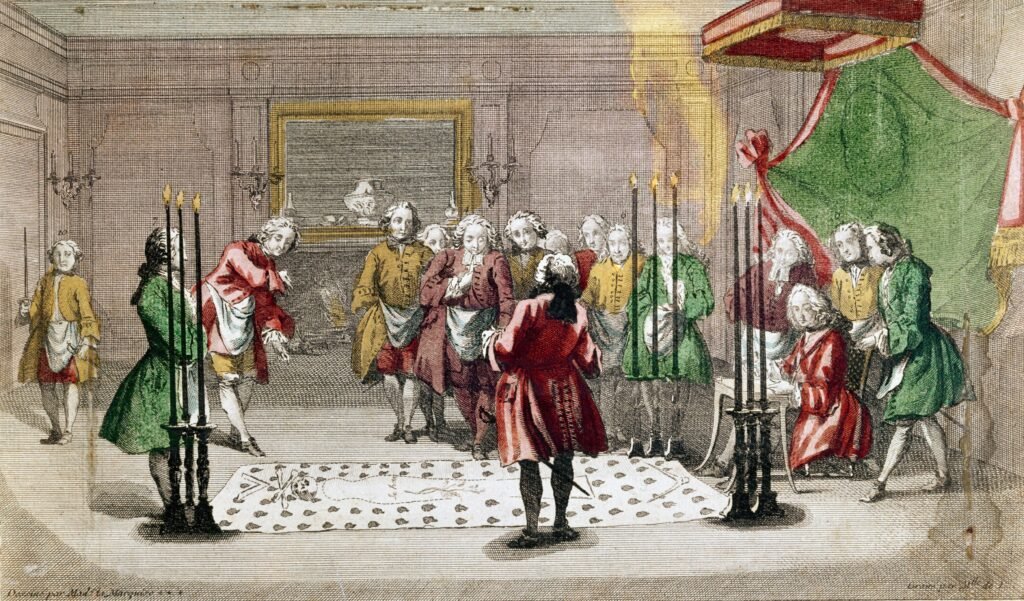
Perhaps no organization has been linked to the Illuminati more frequently than Freemasonry.
Freemasonry existed long before the Bavarian Illuminati.
Its rituals, symbols, and hierarchical structure resembled some aspects of Weishaupt’s organization.
Because many Illuminati members also belonged to Masonic lodges, later writers concluded that the two groups were inseparable.
Historians, however, generally regard them as separate organizations.
Still, similarities in symbolism and secrecy have fueled speculation for generations. Discussions involving Illuminati Secret Societies frequently focus on the relationship between the Bavarian Illuminati and Freemasonry.
Secret Societies Across Europe
Throughout the nineteenth century, numerous secret organizations appeared across Europe.
These included:
Rosicrucians
Mystical groups focused on spiritual wisdom.
Carbonari
Italian revolutionary organizations.
Freemasons
Fraternal societies emphasizing morality and brotherhood.
Skull and Bones
An American society founded in 1832.
Because these groups operated behind closed doors, they naturally attracted suspicion and myth.
Why People Believed the Illuminati Survived
Human beings have always been fascinated by hidden powers.
Several factors contributed to the survival of the Illuminati legend:
- Political instability.
- Religious fears.
- Revolutions and wars.
- Economic crises.
- Distrust of governments.
Whenever societies experienced uncertainty, conspiracy theories flourished.
Large events often seemed too chaotic to accept without searching for deeper explanations.
The Rise of Financial Conspiracy Theories
During the nineteenth century, banking families and wealthy industrialists accumulated enormous influence.
Their economic power gave rise to speculation concerning hidden control over governments and global affairs.
Among the names frequently mentioned were:
- Rothschild family.
- Morgan family.
- Warburg family.
Historians acknowledge their importance within finance.
However, claims regarding secret world domination remain highly controversial and continue to be debated.
The Birth of Modern Illuminati Myths
By the late nineteenth century, the word “Illuminati” no longer referred only to Adam Weishaupt’s organization.
Instead, it had evolved into a symbol.
People began associating it with:
- Secret governments.
- Elite networks.
- Global banking interests.
- Hidden power structures.
- Revolutionary movements.
This transformation laid the groundwork for theories that would later connect the Illuminati to World War I and World War II.
Historians Versus Conspiracy Researchers
Most historians maintain that the Bavarian Illuminati ceased to exist after 1785.
They point to:
- Lack of documentary evidence.
- Absence of organizational records.
- No proof of continuity.
Conspiracy researchers argue that secrecy itself makes such evidence difficult to obtain.
This disagreement has remained unresolved for more than two centuries. Over time, Illuminati Secret Societies evolved from a historical organization into a symbol representing hidden power and unseen influence.
Conclusion: From Secret Society to Global Myth
By the dawn of the twentieth century, the Illuminati had become far more than a small Bavarian organization.
It had transformed into one of history’s most powerful myths. Whether viewed as history or mythology, Illuminati Secret Societies remain one of the most fascinating subjects in modern conspiracy culture.
When Europe moved toward war in 1914, many people would begin asking whether the same hidden forces blamed for revolutions and political upheavals were now influencing the destiny of nations.
Those questions would become even louder after the outbreak of World War I. Readers interested in the historical origins of the Illuminati can explore these resources: Stanford Encyclopedia of Philosophy
Previous Series: The Origins of the Illuminati
To understand how the Illuminati legend survived, it is essential to first understand the origins of the organization itself.
In Series 1, we explored the founding of the Bavarian Illuminati, the life of Adam Weishaupt, and why the organization was eventually banned.
👉 Read Series 1:
The Illuminati and World Wars: Origins of the Greatest Conspiracy Theory
Continue Reading
By the beginning of the twentieth century, the word “Illuminati” had evolved into something far greater than Adam Weishaupt’s original organization..
Theories involving Illuminati Secret Societies had spread across Europe, and many writers began connecting hidden networks to revolutions, political upheavals, and eventually the outbreak of World War I.
In Series 3, we will examine how these ideas became intertwined with one of history’s most devastating conflicts.
👉 Continue Reading:
World War I: Accident, Politics, or Hidden Influence?

Mohit Tejwani is a geopolitics writer and researcher focused on global conflicts, international relations, and military strategy. He analyzes ongoing global tensions and provides simplified insights into complex world events.